

Rate of Rise Settings
Rate of Rise is how fast bean temperature is climbing. Rostoc draws it as the dashed line on your roast chart, read against the scale on the right-hand side.
Two settings control how you read it, and they live together under Settings → Roasting, in a Rate of Rise group of their own. Changing either one takes effect immediately — on the live chart while you roast, and on every roast you open afterwards.
Neither setting changes how Rate of Rise is worked out. They change how it is written down.
Show Rate of Rise
Section titled “Show Rate of Rise”Rate of Rise is a speed, so it needs a length of time to be measured over. By default Rostoc uses a minute: a reading of 12 means bean temperature is climbing at twelve degrees per minute.
You can read it over a shorter interval instead — 30, 15, 10 or 5 seconds. Nothing about the roast changes; the same climb is written in smaller units. Twelve degrees a minute is six degrees per 30 seconds.
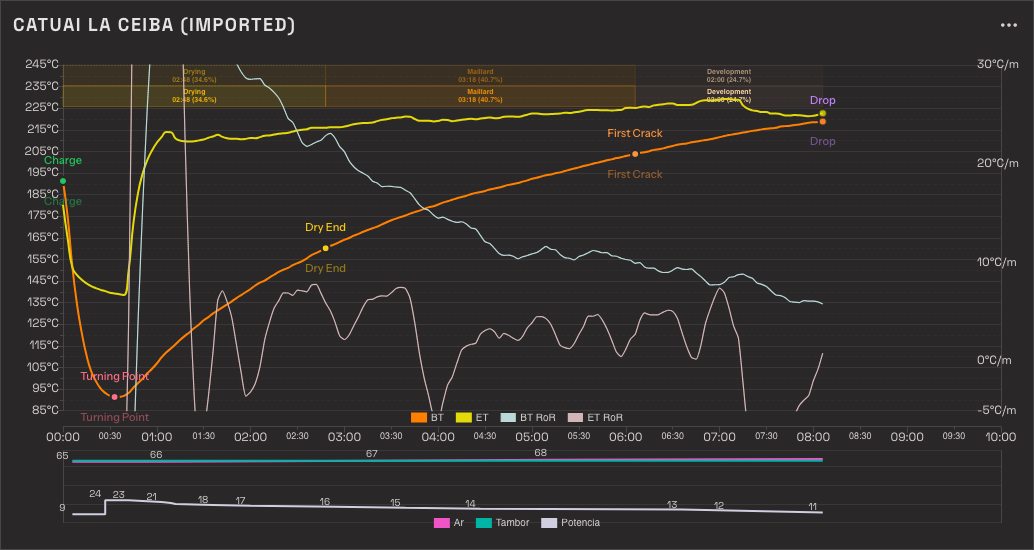
Here is one roast, unchanged, read both ways.
Per minute — the default.
Per 30 seconds — the same curve, the same roast.
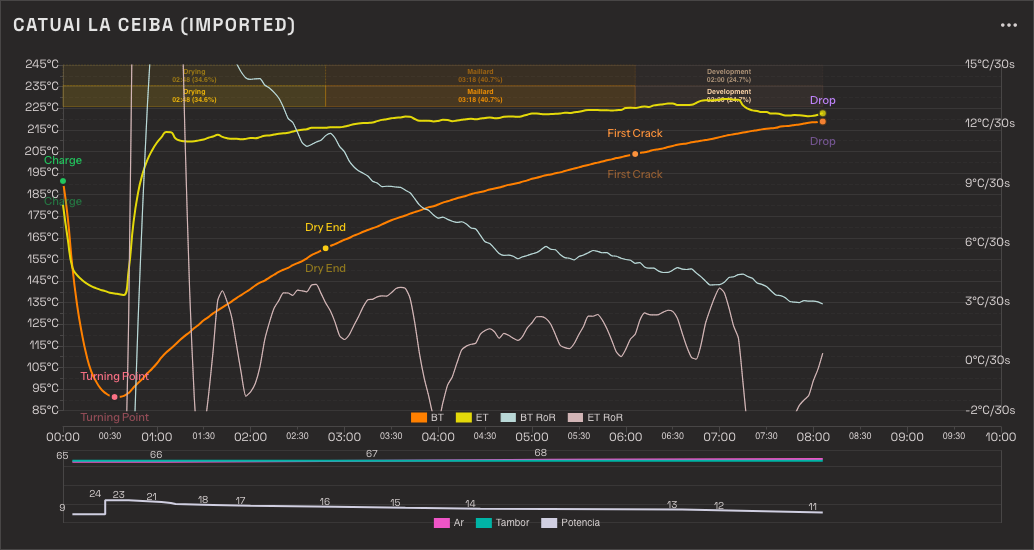
The shape of the line is identical. Only the numbers beside it have changed, and so has the scale they are drawn against.
Shorter intervals suit roasters who think in half-minute steps, or who find whole minutes too coarse to compare batches by. Below 30 seconds the numbers get small enough that roasts start to look alike, so most roasteries settle on per minute or per 30 seconds.
Scale minimum and maximum
Section titled “Scale minimum and maximum”The scale sets the range of the right-hand axis. It starts at -5 to 30 degrees per minute, which suits most drum roasters.
Raise the maximum if your curves run off the top of the chart — a fast sample roaster can climb harder than the default range shows. Lower it if your roasts sit in the bottom third of the chart and you want to see their shape properly. That is what the setting is really for: filling the chart with the part of the roast you care about.
The minimum sits below zero on purpose. Rate of Rise goes negative in the moments after charge, while the beans are still pulling heat out of the drum, and a scale starting at zero cuts that dip out of the picture.
Two things worth knowing:
- Nothing is thrown away. A reading above your maximum is still recorded and still counted in your roast comparison. It is only drawn outside the visible part of the chart.
- The scale follows the interval. Switch to per 30 seconds and every value halves, so the scale halves with it and your curves stay framed the same way. If you have set the scale by hand, Rostoc leaves your numbers alone.
Use Reset scale to go back to the default range. The button appears once you have changed the scale yourself.
Changing temperature units
Section titled “Changing temperature units”Rate of Rise is measured in degrees, so switching between Celsius and Fahrenheit under Application Settings changes it too.
When you switch, the scale resets to the sensible default for the unit you moved to rather than converting your numbers across. Thirty degrees Celsius a minute converts to fifty-four Fahrenheit, and a scale ending at 54 is harder to read than one ending at 55. If you had set the scale by hand, set it again after switching.
What is not adjustable
Section titled “What is not adjustable”How Rate of Rise is calculated — the span of readings it looks across, and how much the line is smoothed — is not a setting. It is the same everywhere in Rostoc: on the live chart, on a roast you open later, and in the comparison against your reference roast.
That is deliberate. If the calculation could vary, two roasts would not be comparable, and the roast comparison score would mean something different from one batch to the next.
Roasts imported from other software
Section titled “Roasts imported from other software”Imported roasts get their Rate of Rise worked out the same way as roasts you record in Rostoc, from the bean temperature in the file.
A file recorded with several seconds between readings has less to work from, and a very coarse one may not produce a Rate of Rise line at all. Rostoc leaves it out rather than drawing a line it cannot stand behind.