Green coffee storage: from delivery to the next roast
A fresh delivery arrives, the roast day is already under way, and the easiest place for the bags is beside the machine. It's a familiar sort of decision: convenient now, worth revisiting before the coffee stays there for weeks.
Updated October 3, 2026 | Rostoc
Good green coffee storage comes down to three habits: protect the packaging, choose a suitable place, and close bags properly between roasts. Keep coffee away from heat, direct sunlight, moisture, and strong odours, with labels that let you follow each lot to its last batch.
You can start with the space and packaging you already have. Here is what to check, what to change, and what to keep an eye on as you use the coffee.
1. Check what arrived before putting it away
Take a moment to inspect the delivery while its labels and shipping information are still together. Look for tears, punctures, wet patches, broken closures, or signs that coffee has escaped. Photograph anything unusual and contact the supplier about how to proceed with affected stock.
Check the inner packaging where you can do so without unnecessarily opening it. A sack can look sound while the liner inside has been damaged. Equally, a scuffed outer sack does not tell you whether the coffee's protective barrier is intact.
Before the paperwork disappears, note the supplier reference, arrival date, quantity, and storage location. Give the lot an identifier you can put on its label. Keep any harvest or crop information too: the arrival date is only one part of the coffee's history.
This record becomes especially useful when the next delivery has the same coffee name. You can keep both familiar names on the shelf while still knowing which delivery you are opening.
In Rostoc, you can track the order before it arrives, including the supplier, expected quantity, and arrival date. When the delivery lands, receive it using the weights that actually arrived. Each receiving row becomes a lot linked back to the order. If two bags weigh 60 kg and a third weighs 30 kg, you can keep those quantities in the receiving record instead of assuming every bag is the same. See the ordering and receiving guide.
2. Understand the bag inside the bag
Outer packaging and inner liners serve different purposes. The outer sack or box helps with handling; a barrier liner is designed to limit exchange with the surrounding air and moisture. GrainPro describes its Premium Zipper product as a polyethylene liner with air and water barrier properties, used inside an outer sack. Product description
If the coffee arrived in suitable, undamaged barrier packaging, keeping it there is a straightforward starting point. Before moving it into a more convenient bin, check that the bin is intended for food storage and offers the protection you need. Ask your supplier if you are unsure about the packaging that arrived.
The liner does the quiet work
What makes GrainPro's Premium Zipper useful is its barrier material and two-track closure. The important question is whether that barrier remains intact and properly sealed. Other suppliers offer barrier packaging too; check the particular product rather than treating every plastic liner as equivalent. GrainPro Premium Zipper
The closure deserves a moment of attention. For its medium/large Premium Zipper bags, GrainPro says to use the slider across the track, then fold the sealed zipper down twice. It also warns that overfilling can reopen the closure. Follow the guide for your exact bag; zipper and tie closures need different handling. Manufacturer's user guide
3. Choose a place you can keep consistent
Look around the space you already have. Is a bag beside a warm wall, in direct sunlight, near a leaking doorway, or next to strongly scented cleaning supplies? Removing those exposures is a useful first improvement.
Start by raising bags and boxes onto suitable shelves, racks, or pallets, and choosing a spot away from direct heat, sunlight, high humidity, and strong odours. These are also the basic handling recommendations in Genuine Origin's storage guide.
Keep the storage area accessible enough to inspect packages and read labels. When arranging stock, leave yourself a workable route to older or already-opened lots. Coffee that disappears behind a new delivery is easy to overlook.
In a hot or humid roastery, write down temperature and relative humidity near the stored coffee at different times of day. That gives you a starting picture of the actual conditions. A reading from the office may describe a different environment. Room humidity is also a different measurement from the moisture content of the beans.
For a simple first check, note readings in the morning and during the warmest part of the working day for a week. Add a note when it rains or the room feels unusually humid. This is a practical observation routine, not a quality test, but it gives you something specific to discuss with your supplier before changing packaging or investing in climate control.
4. Give opened bags a repeatable routine
Prepare what you need before opening a bag: a clean, dry scoop, a suitable weighing container, and the batch quantity. Once you have weighed the coffee, close the liner using its specified method and return the bag to storage.
Keep tools and handling surfaces clean and dry. Watch for anything that could puncture the liner. If you split one lot between containers, copy its identifier onto every container and record where each portion went.
Rostoc can print lot labels with a readable code and a QR code that opens the lot record. Put a label on each sack or container so the person preparing the next roast can find the right delivery without guessing. The label carries the lot's initial weight; scan it to check the current stock in the record. How lot labels work
For example, if you divide a 30 kg delivery between three containers, label each with the lot identifier and its location. A small label such as ‘COL-026 · opened 12 October · prep shelf’ can save a lot of guessing later. Record the quantities if you track stock by container, and record the charged weight when you roast from it.
Avoid adding leftover coffee to a newer delivery simply because the name matches. If you intentionally combine lots, record the components and quantities so the resulting stock still has an understandable history.
The idea came from protecting harvests
GrainPro's founder account traces the company to agricultural storage and humanitarian relief work, with the business starting in 1992. The coffee liner belongs to a broader effort to protect harvested crops during storage. It is a useful way to understand the mechanism: a protective barrier, rather than refrigeration. Founder interview
5. Decide when to use coffee from its condition and history
“How long does green coffee last?” needs more context than an arrival date. Ask about its history before delivery, its packaging, the environment since arrival, and your observations of the coffee.
Give older and opened lots a quick review when planning the week. Which ones have been sitting longest? Which have changed since the arrival sample? Where you sample roast and taste regularly, keep the date, roast record, and observations together. ‘Less fruit intensity than the arrival sample’ gives your next review a useful starting point.
Tasting is a quality comparison, not a way to clear visibly damaged or suspect coffee for use. If a package has become wet or its contents appear abnormal, set the affected stock aside and resolve it with the supplier before putting it into production.
That makes ‘use this next’ a decision you can explain using the coffee's history and condition. Age is worth watching, but an arrival date alone cannot promise how long a particular coffee will taste the way you want it to.
A receiving and storage checklist
- Inspect the outer package and accessible liner; document damage.
- Match the delivery to the supplier reference and assign a lot identifier.
- Record arrival, quantity, units, and location.
- Keep supplied crop information and packaging instructions with the record.
- Store packages off the floor, away from heat, sunlight, moisture, and odours.
- Close opened liners correctly and label every split portion.
- Include older and opened lots in production and quality reviews.
Follow the beans from order to roast
Good storage is easier to manage when the bag and its history stay together. Rostoc connects the order to the received lots, keeps your recorded QC notes with the coffee, records its warehouse location, and links the lot to the batches that use it. Printed labels help you find that same record from the sack on the shelf.
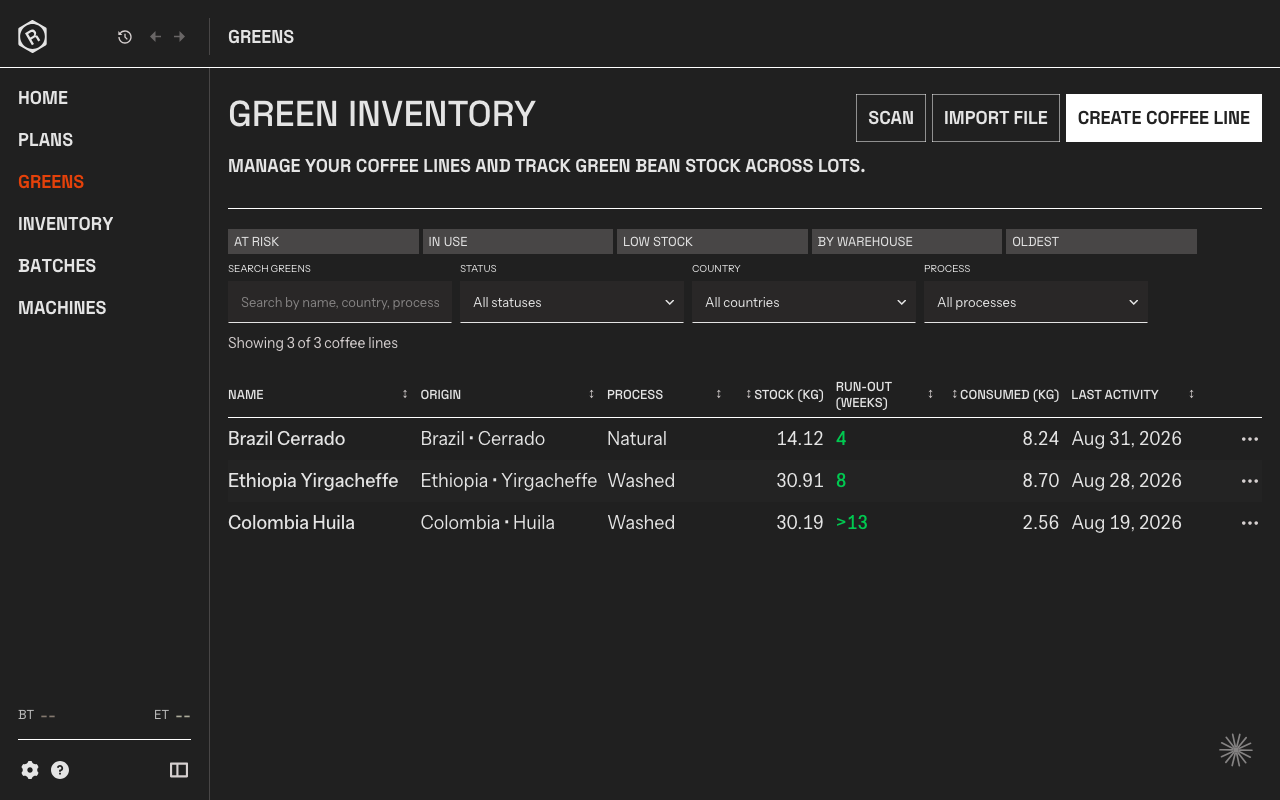
Rostoc's Greens screen brings coffee and stock records together. The Oldest view is a starting point for reviewing older coffee lines; individual lot details hold delivery arrival information. Documentation screenshot with example coffee records.
You can follow the beans end to end through your roastery: order → receiving and recorded QC information → warehouse storage → roasting → inventory transactions. Receipts, roast consumption, adjustments, and stock movements give you a history to return to when a quantity or batch needs explaining.
Explore green coffee inventory in Rostoc, or read our inventory and traceability guide to see what to record at each step.